Founder & Lead Author at StartupSprints · Full-Stack Developer · Jaipur, India
I research and write about startup business models, AI frameworks, and emerging tech — backed by hands-on development experience with React, Node.js, and Python.
Introduction: When Compliance Stays in the Inbox
A food processing MSME outside a tier-2 city receives another PDF: labeling nuance shifted for a category they actually sell. The owner reads the headline, forwards it to a WhatsApp group, and returns to the line. Two weeks later, a batch is flagged during inspection. Nobody “ignored” the law on purpose—the organization simply never converted legal text into inventory holds, artwork revisions, supplier notifications, and training proof. That gap between awareness and execution is where margins die and where RegOps Autopilot earns its name.
If you are evaluating startup ideas 2026 in AI business ideas and automation startups, the winning pattern is not “another legal chatbot.” It is regulatory intelligence that ships work: tasks with owners, due dates, integrations into WMS/QMS/HR tools, and evidence packs auditors can open without calling your COO at midnight. This article breaks down a complete tech startup model for MSME and mid-market operators in India and similar markets—optimized for founders who want depth, not slide-deck vapor.
RegOps sits beside operational stacks like AI-powered inventory systems and agent layers from our AI agents for SMBs guide—because compliance is rarely a standalone island; it is a property of SKUs, plants, equipment, and people.
The Problem: Rule Velocity Beats Management Bandwidth
MSMEs do not lack intent. They lack operational bandwidth to interpret heterogeneous sources—central notifications, state variants, municipal orders, industry association alerts—and then prove they did the right thing under time pressure. Spreadsheets and shared drives decay into archaeology projects within months.
Why generic legal AI search fails in production
Summaries are helpful until a line stops because nobody quarantined the right lot. Production systems need deterministic applicability (“this SKU, this plant, this supplier tier”) and closed-loop execution (tickets closed, signatures captured, photos stored). That is a different product category—closer to workflow automation plus compliance ontology than to a browser sidebar.
- Fragmented sources: PDFs, portals, emails, and verbal “heard from association” updates compete for attention.
- High cost of wrong applicability: False positives waste shifts; false negatives invite penalties or recalls.
- Evidence debt: Audits demand trails; ad hoc screenshots fail under scrutiny.
- Integration gap: Legal teams rarely own WMS master data—so compliance must meet operations where data already lives.
The Business Idea: From Bulletins to Executable Workflows
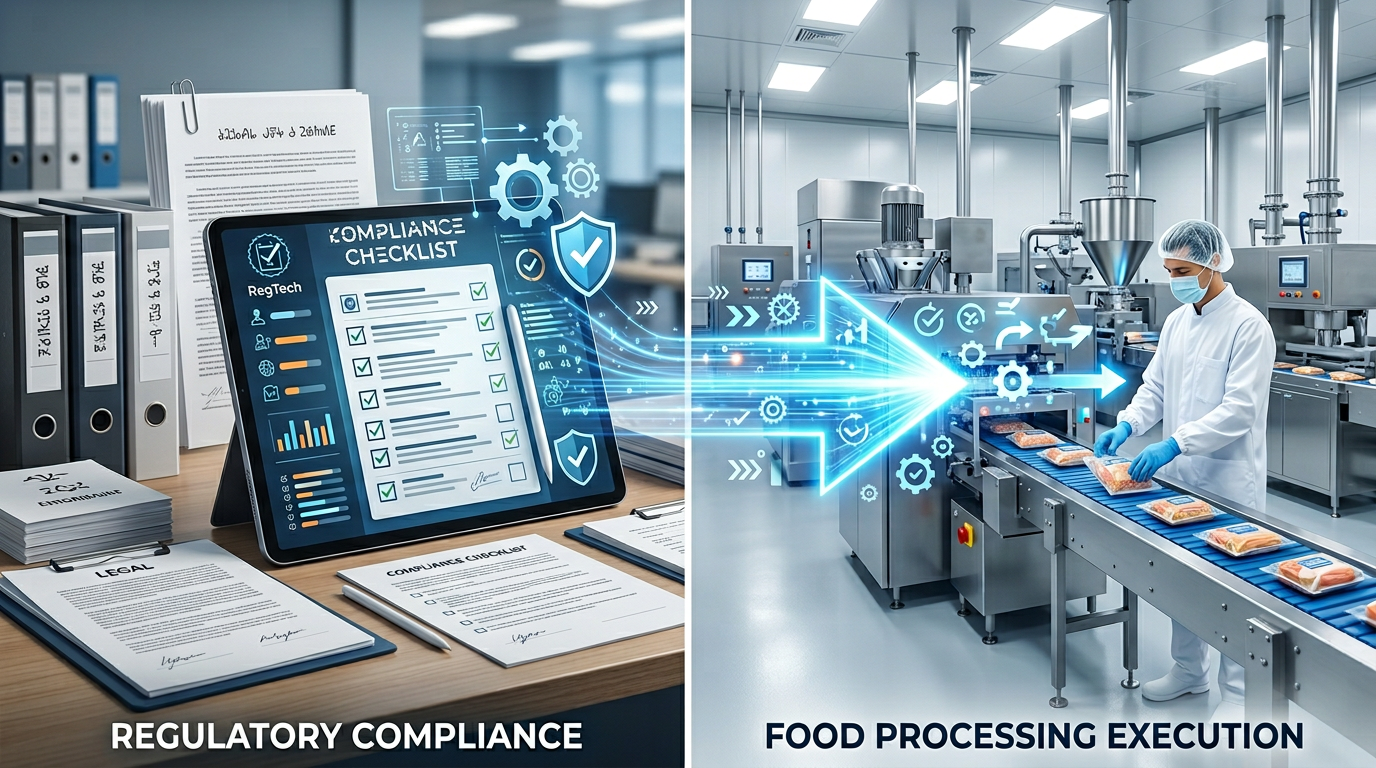
RegOps Autopilot ingests official and curated industry feeds, maps changes onto a company’s operational graph (SKUs, BOMs, plants, licenses, suppliers, equipment), and emits executable plans: quarantine rules, label regeneration tasks, supplier acknowledgements, micro-training modules, and document version control. Humans review high-risk jurisdictions during early deployments; the system learns your vocabulary (“masala mix B” equals which regulatory family).
Positioning line that wins CFO trust
“We do not just tell you what changed. We tell you what to do Monday morning, who owns it, and where the evidence lives—integrated with the systems you already run.” That sentence is how future business trends in RegTech become purchase orders.
How It Works: Operational Logic
- Profile construction: Import SKU masters, facility licenses, process flows, and supplier tiers—via CSV, ERP APIs, or guided onboarding.
- Ingestion pipeline: Poll portals, parse PDFs/OCR, normalize association bulletins; tag jurisdiction and effective dates.
- Applicability engine: Rules + retrieval-augmented models propose affected objects—always with citations to source clauses for reviewer sign-off.
- Planner: Expand changes into task DAGs with SLAs, dependencies, and escalation if acknowledgements stall.
- Execution adapters: WMS holds, QMS CAPAs, e-sign, LMS micro-lessons, label print queues.
- Continuous monitoring: Diff incoming sources; reopen tasks when regulators amend text mid-flight.

Technology Stack
Document & knowledge layer
OCR, layout-aware parsing, chunking strategies that preserve section hierarchy, and citation-grounded LLM outputs so reviewers can sanity-check every automated claim. Version source documents immutably for audit.
Ontology & rules
A semantic layer maps legal concepts (“pre-packaged food”, allergen declaration changes) to operational entities. Keep a hybrid: rules for hard constraints, models for fuzzy mapping—especially across Indian state variants.
Workflow engine
Durable workflows with idempotent integrations (retries, dead-letter queues). Compliance tasks are long-running; users abandon brittle scripts.
Integrations & security
ERP/WMS/QMS connectors, SSO, on-prem option for sensitive plants, and tamper-evident evidence storage. For SEO and trust, publish security whitepapers—buyers search for them.

Real-World Scenarios
Scenario A — Spice packer, multi-state distribution
A state order adjusts declaration text for a subset of SKUs. RegOps identifies fourteen SKUs, opens artwork tasks with designer deadlines, places WMS quarantine flags until QC sign-off, notifies three co-packers with read receipts, and assigns a ten-minute training module to packing leads. The GM sees a single dashboard: “All affected batches tracked; two suppliers pending acknowledgement; zero lines shipping noncompliant labels.” That is automation startups delivering measurable risk reduction.
Scenario B — Cosmetics MSME facing export documentation
Export packaging rules shift; the system correlates SKU export destinations, generates differentiated task sets per destination, and attaches evidence requirements (photos, COA references). Sales stops promising impossible ship dates because the workflow blocks quotes until compliance clears—a revenue protectant, not just a cost center.
Revenue Model
- SaaS per facility / regulated product line complexity tier.
- Urgent incident fees when circulars demand same-week execution—high willingness-to-pay.
- Vertical packs (food, chemicals, clinics) with pre-built ontologies and checklist libraries.
- Enterprise API for insurers and lenders monitoring operational assurance—not just financial ratios.
Anchor annual contracts after two clean audit cycles; expansion revenue via additional plants and export lanes.
Market Potential
Food, cosmetics, chemicals, pharma adjacencies, logistics yards handling hazardous classes, and franchised retail chains face accelerating rule volume. India’s MSME digitization push and global ESG-adjacent labeling trends extend TAM. Position explicitly for startup ideas 2026 readers comparing AI business ideas—your ICP is COO + plant head + compliance lead, not generic “legal.”
Competitive Landscape
- Legal research SaaS: Strong search; weak closed-loop execution.
- Consulting firms: Deep; does not scale as software margin.
- Generic AI wrappers: Fast demos; missing ontology + integrations + audit trails.
- QMS incumbents: Powerful inside quality; narrower on multi-source regulatory ingestion.
Win on time-to-safe-shipment KPIs, not feature checklists.
Go-to-Market Strategy
- Start in one vertical + one geography with a reference auditor who will speak on record.
- Publish anonymized before/after audit prep time metrics—SEO gold for long-tail queries.
- Partner with industry associations for distribution and training.
- Sell bundled onboarding sprints; migrate to self-serve templates once ontology stabilizes.
Scalability
Ontologies and adapters reuse across customers; ingestion pipelines amortize. Partner ecosystem (label printers, LMS vendors) expands ARPU. Strong documentation improves organic search for “MSME compliance automation India” and related tech startup models queries.
Risks & Mitigation
- Incorrect applicability: Human-in-the-loop thresholds, golden tests per vertical, customer-specific override logs.
- Liability perception: Clear contracts—decision support, customer retains accountability; insurance as you scale.
- Integration fragility: Idempotent connectors, sandbox programs with ERP vendors.
- Model drift on law: Continuous source monitoring and diff alerts—not annual refreshes.
Why This Idea Can Win
- Sticky workflows embedded in shipping paths.
- Procurement urgency spikes after incidents—fast deployment wins.
- Defensible depth versus horizontal AI tools.
Future Expansion
Computer-vision line audits for label match, robotics-assisted physical segregation, and cross-border regulatory packs for exporters. Each module deepens future business trends positioning without diluting the RegOps core story.
FAQ — RegOps Autopilot, MSME Compliance AI & Workflow Automation (2026)
What is RegOps Autopilot in simple terms?+
Software that reads regulatory and industry updates, determines what applies to your SKUs and plants, and automatically creates integrated tasks—quarantines, label changes, trainings, supplier notices—with audit evidence.
Is RegOps legal advice?+
No. It is decision-support and workflow automation. Legal counsel should review policies in sensitive domains; the product must expose citations, confidence, and human approval gates.
Why is this a top AI business idea for MSMEs in 2026?+
Model quality for document understanding crossed usability thresholds, while regulatory volume keeps climbing. Buyers now demand execution, not PDF summaries—perfect timing for automation startups with ontology depth.
Which integrations matter on day one?+
Ticketing, document storage, and one WMS or inventory system in your chosen vertical. Prove fewer integrations deeply before spraying connectors.
How do you make this SEO-friendly for Indian founders?+
Target long-tail clusters: MSME compliance automation India, FSSAI labeling workflow software, regulatory RAG with citations, and tech startup models for RegTech—use them in H2s, image alt text, and FAQs without stuffing.
What metrics prove ROI?+
Hours saved before audits, reduction in nonconforming shipments, supplier acknowledgement SLAs, and time-to-quarantine for affected lots.
How does this differ from generic ChatGPT for compliance?+
Grounded retrieval, integration adapters, durable workflows, tamper-evident evidence, and vertical ontologies—enterprise requirements generic chat cannot meet.
Can RegOps expand beyond India?+
Yes—export labeling, REACH-like chemical regimes, and multi-plant multinationals need the same execution spine with different source feeds.
Have Questions About This Idea?
Ask our team — we'll get back with detailed advice.